SEARCH
Monitor archives:

Copyrighted material


The 404 Reports

Summaries of under-reported news, updates on previous Monitor stories

[Editor's note: Before there were blogs, there were the Monitor "404 Reports," which began in 1997 as a forum to offer updates on previous Monitor stories and discuss items in today's news that deserved greater media attention. Significant additions or changes to the Albion Monitor site will also be announced here. Do not bookmark this page, as the 404 Reports address will change with each edition.]


Rehnquist obituaries gloss over career, damage to rights

  + REQUIEM FOR A HEAVYWEIGHT VILLAIN  
ALSO IN THE MONITOR

Rehnquist Led Supreme Court To The Right

Supreme Court Hissy Fits

Supreme Court Upholds Cruel "One Strike" Policy

Supreme Court's Scary Decision Unites Right, Left (2001)

Surprise -- Voting for President is not a Right (2000)

Irreparable Harm to Supreme Court Credibility (2000)

Supreme Court Weakening Fourth Amendment, Study Finds (1997)

The Anti-Trust Juggernaut Crushes the Little Guy (1997)

In the midst of the horrors brought by Hurricane Katrina in the first week of September, America was also shaken by the death of a great man: Supreme Court Chief Justice William H. Rehnquist. Most of the newspaper coverage found him euolgized him with reverence. Gone was a "courteous ... affable figure with a great poker face" (Knight Ridder), a " beloved boss...quick to crack jokes and poke fun at himself" (AP) who was "appreciated for his evenhandedness and calm" (Washington Post) and "enjoyed hosting the court's holiday party every year, leading the other justices, clerks and staffers in singing Christmas carols" (Houston Chronicle). Had Tiny Tim been at the party, no doubt the lad would have been balancing atop the Chief Justice's kindly stooped shoulders.

What hokum. Rehnquist was a posturing, vain man with a penchant for humiliating practical jokes, a tyrant on the bench and known as a short-tempered bully. Rehnquist may have been a jolly caroler at Christmastime, but the rest of the year he was uncaring Mr. Scrooge, with goodwill reserved for only the rich and powerful. As Alan Dershowitz wrote on the Huffington Post, "He sometimes moderated his views for prudential or pragmatic reasons, but his vote could almost always be predicted based on who the parties were, not what the legal issues happened to be. He generally opposed the rights of gays, women, blacks, aliens, and religious minorities. He was a friend of corporations, polluters, right wing Republicans, religious fundamentalists, homophobes, and other bigots."

An isolated, conservative idealogue when appointed by Nixon, later additions to the Court by Reagan forged the "Rehnquist Five" bloc that often voted along ideological grounds rather than sound jurisprudence, most famously in deciding the outcome of the year 2000 presidential election. Rehnquist led the Court in throwing out a federal law banning possession of a gun within 1,000 feet of a school, approving random drug tests for students (which he himself might have failed during his long addiction to the prescription drug, Placidyl), and allowing church-run schools to receive taxpayer-funded tuition vouchers. He voted with the 5-member majority in 1986 in declaring that gays have no constitutional rights to privacy even in their own homes.

His extremist views were most on display when he was on the losing side and writing dissenting opinions that revealed his fuzzy thinking. He said flag burning should be outlawed because many people have "an almost mystical reverence" for the stars and stripes. He opposed affirmative action in college admission and a law that barred execution of the mentally retarded as "cruel and unusual" punishment. He voted against Roe v. Wade, writing "a transaction resulting in an operation such as this is not 'private' in the ordinary usage of that word."

Rehnquist was such an extremist that he could even make Scalia and Thomas appear lefty, and was never shy about his desire to impose religious views on the Court. He wanted the Supreme Court to declare the pledge of allegiance constitutional, and fought to allow public displays of the ten commandments, which was his final, deathbed vote. In 1985, he wrote that there was no constitutional basis for keeping religion out of government affairs: "The 'wall between church and state' is a metaphor based on bad history, a metaphor which has proved useless as a guide to judging," he wrote. "It should be frankly and explicitly abandoned."

By being shy of speaking ill of the dead, Dershowitz bemoaned that newspapers have left posterity with an utterly false portrait of the man: "History requires truth, not puffery or silence, especially about powerful governmental figures. And obituaries are a first draft of history." He's right; history demands a fair portrait of Dearly Beloved without it being filtered through a gauzy lens, and few obits can be found that even hinted that there might be tarnish on his legacy. It's comparable to reading in a profile of Civil War General Sherman that he once took a long horseback ride through Georgia with some friends of his, stopping to visit with locals along the way.   (September 17, 2005)


Louisiana's wetlands and the New Orleans flood

  + WHAT BUSH WROUGHT AND DIDN'T  
ALSO IN THE MONITOR

Molly Ivins: Nothing Wrong With Blaming Bush For New Orleans Flooding

Loss Of Wetlands Left Gulf Coast Vulnerable

Bush Rolls Back Wetlands Protections

Bush And The Conservation Reserve Program

Carolinas Encouraged Building in Flooded Areas (1999)

Restore Wetlands to Stop Big Floods, Researcher Says (1997)

Time has come to pity the Rove. Here poor Karl has devoted over a decade to burnishing the image of George W. Bush as America's competent, compassionate Dear Leader, only to find his life's work on wobbly legs following Hurricane Katrina. Nine days afterward, polls showed about 3 of 5 disapproved of his job on disaster relief, a complete opposite of figures from the week before. Bush approval ratings sank below 40 percent for the first time. Surely Rove blames the heavy media coverage of New Orleans' unrelenting misery, but Bush made his own mistakes. First there was the photo of him clowning with a guitar even as disaster struck, inviting easy comparisons to Nero and fiddles. Then there was the president's comment that no one foresaw the levee's collapsing, when it was clear that everyone predicted exactly that. And then there was this remarkable exchange on September 6 as later told by Rep. Nancy Pelosi, who urged him to ax FEMA director Michael Brown. "Why would I do that?" Bush asked the House Democratic Leader, "what didn't go right?" Pelosi commented to the press, "Oblivious, in denial, dangerous."

The federal government's disgracefully laggard response to the emergency is reason enough for anger at the Bush administration, but it was their refusal to budget simple, inexpensive flood control projects that turned the storm's damage into a catastrophe. Funding began to dry up in 2003, with the money being diverted to the Iraq War. Each year since, the situation has steadily gotten worse. The White House earlier this year promised Louisiana only $10.4 million for its chief hurricane protection project -- a sixth of what was needed. The Army Corps of Engineers were denied $4 million for a four year study on protecting New Orleans from a category 4 or 5 hurricane and ordered to forget about starting any new studies for the region (MORE on federal funding issues).

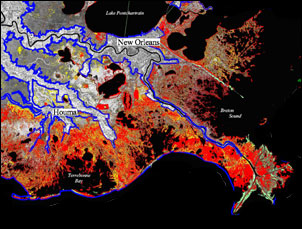
Another main factor was the pitiful condition of Lousiana's wetlands, which normally buffer the powerful waves of hurricanes. Since 1930, Louisiana has lost 1,900 square miles of coastal wetlands, and continues to lose another 35-40 sq. miles every year -- the equivalent of an acre of land every 35 minutes. Politics are to blame here, too; for years, Louisiana, the Army Corps, and enviros have failed to get Congress to seriously consider a three-decade, multi-stage plan for restoration. If all that coastland hadn't been lost over the years (see map to right), New Orleans probably wouldn't have taken such a wallop.

 hat
Areas in red show wetlands lost 1932 - 2000 (USGS)
Critics also blamed Bush for Lousiana's wetland loss, starting with a widely-reprinted Sept. 1 column by Sidney Blumenthal:

...The Bush administration's policy of turning over wetlands to developers almost certainly also contributed to the heightened level of the storm surge. In 1990, a federal task force began restoring lost wetlands surrounding New Orleans. Every two miles of wetland between the Crescent City and the Gulf reduces a surge by half a foot. Bush had promised "no net loss" of wetlands, a policy launched by his father's administration and bolstered by President Clinton. But he reversed his approach in 2003, unleashing the developers.

Probably by coincidence, Molly Ivins wrote much the same thing in her column about Hurricane Katrina published the same day. "It is a fact that the Clinton administration set some tough policies on wetlands, and it is a fact that the Bush administration repealed those policies -- ordering federal agencies to stop protecting as many as 20 million acres of wetlands," she wrote. "...Bush administration's policies had allowed developers to drain thousands of acres of wetlands."

But in this one instance, Bush is getting a bad rap; as experts from three Gulf wetlands restoration groups told MONITOR this week, there's been no rampant development in the areas in question, because of Bush policies or no. The only construction anyone could think of that might have somewhat worsened flooding was in shorline Lake Pontchartrain communities such as Slidell.

You can certainly charge Bush with neglect of the Louisiana wetlands, but the damage there was caused by ongoing abuse, particularly short-sighted "improvements" to the waterways for navigation. The other major cause of the loss of Louisiana's wetlands has been the result of oil and gas extraction activities. "The energy industry has placed pipelines and dug channels through the marsh to convey oil and gas to its processors and transporters," explained Susan Kaderka, Director of the Gulf States Natural Resource Center for the National Wildlife Federation. "These channels have allowed salt water from the Gulf to intrude into freshwater marsh areas, killing off vegetation that is not used to salt water. As the vegetation dies, the soil it was holding in place just slips away, and what was once a continuous marsh becomes a sort of swiss cheese pattern, with large areas of open water."

It's important to note that Blumenthal, Ivins, and others that have since mentioned Bush's damage to wetlands are also fundamentally correct, when it comes to the rest of the country. Changes in 2003 to the Clean Water Act eliminated the need for permits when wetlands are destroyed or polluted, as long as the area is within a single state and not part of a navigable waterway. That almost all Louisiana wetlands are connected to lakes, rivers, or the Gulf spared them from the loophole.

Bush has also perverted the Conservation Reserve Program into a giveaway for big agribusiness. The original CRP, which began in 1985, became a major conservation program that reversed the loss of wetlands. It now includes 800,000 more acres of grassland, border farmland, and non-floodplain wetlands. And here's the ugly catch: Those lands will also be exempt from any environmental protection. This might allow a slaughterhouse, for example, to not only dump animal waste in a seasonal wetland (Bush calls 'em "Prairie Potholes") without worry of government penalty, but also be paid about $60/acre for the pleasure.

In other times, other places, debating whether a two year-old policy change led to environmental damage significant enough to affect the flooding of New Orleans would be a quibble. But in year 5 of Era Bush, we know how the game works; FOX and the gaggle of spinners will use any flaw to discredit voices of the opposition, like tugging on a sweater's thread until the whole thing unravels. Before we know it, attention could be diverted away from Bush's very real complicity in the underlying causes of the tragedy and we might find ourselves plunged into a national debate about building permits in southern Louisiana parishes, or some other mordant distraction. Anyone who doubts that the Bush troops would twist an issue as important as the New Orleans flood should have a sit-down with John Kerry, or any of the other victims flattened by their steamroller.   (September 11, 2005)


What's to become of newspapering?

  + ALL I KNOW IS WHAT I READ IN (ANYTHING BUT) THE PAPERS   Mark your calendars; National Newspaper Week begins October 2 this year, and it's the 65th anniversary of the celebration. Ol' NNW hasn't aged a day -- nor has it progressed beyond 1940, judging by the publicity materials from last year's fest. Members of the newspaper association were offered an ad featuring vaudeville comic Will Rogers (very popular when he died in 1935), diagrams of how to fold a newspaper into a traditional pressman's hat (probably last seen by most in some pre-WWII movie), and an edgy editorial cartoon titled "No Battery Required," showing a middle-aged guy reading a paper ("In-depth coverage, anywhere, anytime") next to a kid with a fizzled laptop. All in all, it was a perfect riposte against those who view newspapers as dying media dinosaurs. Not.

 hat
Pressman's hat or editor's worry beads?
There is no disputing that newspaper popularity is sliding; readership began tumbling downhill about twenty years ago, accelerating with the growth of cable TV and the Internet. Research by the Pew Center shows only half of the public now believes what they read in the paper, down from 80 percent in 1985. Today, fear and loathing for the future of newspapering is never long unmentioned in journalism discussions. When Philip Meyer, author of "The Vanishing Newspaper: Saving Journalism in the Information Age" predicted at a recent forum that the last newspaper will roll off the presses in April, 2040, it inspired the frantic terror you'd expect from dropping a firecracker in an anthill. A goodly number of scribes appear still in shock over the idea that doomsday approacheth, and are probably seeking solace by busily folding boxy pressman's hats from yesterday's edition.

Newspapers won't really follow the town criers into history; non-newsprint versions like the Albion Monitor -- edited journals containing a variety of news for a general audience -- always will be around. The modern American newspaper may even be the last kind of print media to survive; even in an ultra-electrionic age it is still a thing of wonder, and until they come up with a way to jack a wire directly into your brain for instant download, there's not going to be a more efficient system for delivering the goods. From pushing the more important stories to the front of the paper to the inverted pyramid writing style of news articles, newspapers have evolved into the means of conveying the most possible amount of information as fast as possible.

ALSO IN THE MONITOR

Why Newspapers Are Dying

It's the Content, Stupid

What Do Newspaper Readers Really Want?

Newspapers Are Dumbing Down America, Author Says

Greed And Newspapering

NY Times Admits Misleading Reporting -- Two Years Later

Judy Miller's War

The Downing St. Memo and the press

Pressure Grows On Bush Over Global Warming

Enough of the hooraying; in practice, newspapers are just as deeply flawed as other forms as media, perhaps even more so. The same basic design strengths that streamline delivery of the latest news can also make newspapers prone to leave you badly misinformed -- and not because of any liberal bias, conspiracy, or other wacky fun that Fox News pundits might dream up.

Start with the familiar complaint that [insert important story here] didn't receive the big front page splash that it deserved. Despite declining readership and credibility, newspaper front pages are still totemic objects that shape the very news they report; even in this Internet age, a story's importance is often measured by the kind of front page coverage it receives.

No newspaper acreage in the world has more gravitas than the front page of The New York Times, and stories that appear there are treated as gospel. Even those who view the paper with scorn treat the Times' front page as an icon. When Ann Coulter wanted to show how East Coast snobs hated regular folk, she wrote that the Times didn't run a front page piece about the death of NASCAR star Dale Earnhardt for two days, and then pointed an accusing (but well-manicured!) finger towards an article that began, "His death brought a silence to the Wal-Mart." As usual, she lied -- a straight news story did appear on the front page the very next day, and what she thought was a snooty essay was authored by Alabama's Rick Bragg, winner of a Pulitzer for his descriptive coverage of contemporary American culture.

Every front page magnifies stories appearing there, and that's particularly true for The New York Times. Items from that page one will likely be broadcast on the evening news, summarized by the wire services, ripped-off by ten thousand bloggers, and otherwise spread everywhere. Times front page stories influence elections, national policy -- and even launch wars. Trouble is, when facts in those stories are wrong, the error is also magnified. A goodly part of the blame for the Iraq War goes to the Times' breathless 2001-2003 front page reporting by Judith Miller and others describing Saddam's hidden mad scientist biolabs and proto-atom bomb factories. Before that, there was the Times' 1999 libel against Wen Ho Lee, the naturalized American citizen accused of giving China some of America's nuclear secrets. Before that, there was the Times' error-ridden 1992 investigative report on Whitewater, which Clinton critics quoted in following years to "prove" the president was devilish. The trail of front page flubs goes back as far as you want to look; in 1920, Walter Lippmann and a colleague pointed out that the Times reported the Soviet regime had collapsed or was about to fall nearly a hundred times between 1917 and 1919.

There's lots more about front pages that sharks can thrash over; dedicated readers bicker about story placement above/below the fold, column inch count, and choice of photos like members of a crazed typography cult. Truly obsessive page-one junkies can even compare the shortcomings of their favorite paper to other front pages around the world at the wonderful Newseum website (select "map view" if you have a recent version of Flash). But the fundamental problem is that an erroneous front page story can do enormous damage that may be impossible to fix without extraordinary efforts; papers should make significant corrections to page one stories on the front page itself, not buried somewhere deep inside the paper months or years later. That is, if a correction is offered at all; the Times eventually published half-hearted apologies for their errors in the Wen Ho Lee case and flaws in the WMD stories, but none for the smear against Clinton. Credibilty also must start on page one; why can't a newspaper -- particularly a paper as influential as the Times -- declare war on error?

Another fundamental media problem is the fast turnover of our modern news cycle, which doesn't give stories much time to be noticed before they sink below the horizon, probably lost forever. Usually blamed is the "24/7" pressure from TV and the 'net, but it's really the same game that's existed since the early Twentieth Century, when newspapers fought epic circulation wars, competing by churning out several daily editions that. each promised the very freshest news. Back then it was a destructive to good journalism, and it still is today; the result is a media serving up an unhealthy diet of celebs-and-sensation "junk food news," as Project Censored founder Carl Jensen dubbed it.

The punishing pace of the news cycle results in the crime of omission, a constant topic in these 404 Reports and other media criticism. But the real damage extends far beyond today's orphaned stories; also missing are followups on yesterday's big news. Remember the Christmas tsunami? Although the tragedy was the top story for days and an unprecedented number of Americans donated money to the relief effort, scant coverage has reported what's happened since -- that much of the aid never reached the people in need, and big countries welshed on their generous pledges.

Constantly watching the latest feed rolling off the wires lends editors to develop an odd myopia that prevents them from seeing what's really newsworthy. A remarkable example of this happened in the recent push and shove between readers and newspapers over the Downing Street Memo. As an avalanche of letter demanded coverage of the Memo, newsrooms simply didn't grasp why anyone would care about newly disclosed details of events dating back to 2002. The disconnect between readers and their newspapers was so great that Washington Post columnist Dana Milbank actually implied that the Memo wasn't newsworthy because everyone should already know that Bush was gaming the system after 9/11 to justify an attack on Iraq. Dana, you need to get out of the office more.

The tragedy is that newspapers don't have to run themselves to death chasing the news cycle to compete with broadcasting's "rip and read" headline news. Readers don't even want that; a 2004 Pew study found only 18 percent of the public care merely about headlines, and 40 percent wanted newspapers to provide thoughtful analysis (the rest wanted some combo of headlines and facts).

What would your favorite daily look like, in a brave new world of newspapering? For starters, readers would be offered regular installments about developing stories that have complex backgrounds. In this alt universe, papers would have mesmerized readers this summer by reporting the latest developments in the Jack Abramoff scandal. Here is a story that reads like a red-meat paperback thriller, complete with a unsolved, gangland-style murder of a partner following a shady business deal. An intimate to the top echelons in the Republican party -- his association with Karl Rove goes back to college days -- Abramoff funnelled millions in lobbying money from casino-rich Indian tribes to GOP politicians and front groups as well as supporting right-wing causes (among them a sniper school for Israeli colonists living in the West Bank). A new skeleton has tumbled from his closet almost every week recently; the latest is that those California and Mississippi tribes made hefty 2002 donations to the New Hampshire Republican party as it was running a "dirty tricks" operation, jamming Democratic party phone lines on election day. Abramoff's tale is probably the greatest political scandal since Iran-Contra, and likewise has so many characters and plot twists that readers need a running start to follow the action. But without ongoing coverage, understanding the most recent events is as hopeless as opening Charles Dickens' "Little Dorrit" to chapter 27 and trying to unravel what banker Merdle did to poor Mr. Clennam.

Newspapers in that better world would always try to help readers understand stories in context. Some possible changes are easy, and even could be made in time for tomorrow's editions:

  • Frequently include sidebars to identify people, places, and things. Use maps. A search of Nexis shows "restive Anbar province" has become a cliche, appearing in over 100 different newspaper articles so far this year. Fine 'n' dandy -- but how many people can name its largest cities? Pinpoint it on a map? (For that matter, how many newspaper readers can accurately locate Iraq?)
  • Offer more analysis and commentary, and not just from the usual suspects; women and minorities are rare visitors to most op/ed pages. When was the last time your daily paper offered viewpoints about the Terror War from a Muslim or Arab, for example?
  • Speaking of the op/ed pages: lose 'em. There's no good reason for commentary to be segregated away from news articles about the same subject. Sure, commentary has to be clearly labeled as such, but there are many ways to graphically make it clear that a particular article is someone's opinion. If the reader's seeking information on (say) Iraq, everything in that edition should be mostly collected together.
  • Newspapers could refer readers to their own webpages for more background -- but don't hold your breath they would ever do such a sensible thing. Rarely do newspapers offer any sort of supplimental material online; most papers treat their Internet site like an inchoate poor cousin, useful for only up-to-date weather, scores, and classifieds. What news items that do appear on newspaper websites are almost always just duplicates of top stories from the print edition. The quality of these websites is likely to get worse, not better; AP will soon begin charging fees for use of its articles online and it's expected that most papers won't pay, leaving the web pages with just local news. It doesn't have to be this way -- see the NY Times' 9/11 page for a superb example of what could be done.
  • Editors could hold some stories with an eye on combining them later into a news feature. Every newspaper already has an inventory of "evergreens," ranging from back-to-school checklists to human-interest features; some news articles could be easily held for days, even weeks or months beyond the regular cycle for presentation with related stories.

     Siberia
    Researchers discovered that the permafrost of western Siberia's permafrost is thawing for the first time in 11,000 years. The melting peat bog, as big as France and Germany combined, may cause a catastrophic release of billions of tons of methane, a greenhouse gas 20 times more damaging than carbon dioxide
    Events earlier this month showed how readers could be better served by aggregating news items together. Within a few days, three different global warming discoveries were announced. The environmental group WWF released a report showing European cities have warmed up over 2 degrees C since the early 1970s; a 5-year UN study predicted all of the world glaciers could melt within decades; and a group of scientists reported that Siberia's permafrost is thawing for the first time in 11,000 years. All three stories were reported widely in European and Asian newspapers, but only the Siberia item received any coverage at all in the U.S, with a 125-word short in the Washington Times (a story about the WWF report appeared in the Albion Monitor).

    Had the stories been presented together, they would have grabbed attention; but running them piecemeal -- or in the case of the American press, not at all -- the impact was small, narrowly limited in the U.S. to ardent bloggers and visitors to enviro websites. Lost was the chance to make an impression on a wide audience about a pressing global problem, and lost was a challenge to nay-sayers like President Bush who posture that "the jury's still out" about global warming.

    They say recognizing your problem is the first step, and it's a positive sign that so many journalists are talking about the bleak future of newspapers. But the fundamental problem is that newspapers are working against their own interests in so many ways. Instead of endless hand-wringing about print media's possible demise in a competitive world with broadcast headline news or Internet news portals, the right question to ask is this: How to make a newspaper a better newspaper?   (August 31, 2005)


Site updates

  + CHANGES TO THE ALBION MONITOR WEBSITE   The tsunami archive and sweatshop archive have been updated.

Technorati has been added as a menu option on our search page. Technorati indexes about 16 million blogs and items linked from those pages, and is quickly becoming an indispensable tool for Internet researchers.   (August 30, 2005)


When Is Science News?

  + POT, KETTLE, BLACK, ETC.  
ALSO IN THE MONITOR

Nobel Laureates Endorse Kerry, Blast Bush For Ignoring Science

"Intelligent Design" Hearing Ends In Kansas

Water Discovered On Moon

The Poor Health Of Reporting On Health (1998)

Press Relies On Non-Profits To Expose Science Fraud (1998)

The Passive Press

Hey, didj'a hear about the latest ignorant remark from Bush? At an August 2 roundtable session with reporters, he said "intelligent design" should be taught in schools next to evolution "so people can understand what the debate is about... people ought to be exposed to different ideas."

Those terse, almost offhand comments by the president became the focus of newspaper coverage of his press meeting. Stories mentioning Bush's creationist views appeared in probably every daily, followed by a wave of negative editorials and columns. A sample: "When it comes to science, President Bush is of two minds, one of which is wrong." (Rocky Mountain News) "By aligning himself with that approach, Mr. Bush undermines his efforts to elevate educational standards." (Baltimore Sun) "This really borders on madness." (Washington Post)

Bush's remarks are worth criticizing; it really was a lamebrain thing for him to say. If he really wants to expose people to new ideas, what next? Maybe we should teach numerology along with math, alchemy next to chemistry, and phrenology along side psychology (okay, maybe the last two are equivalent).

At the same time, there's something out of balance with all that media coverage. Bush's comments were clearly personal, not recommendations by the president for legislative or policy changes. Read the whole transcript and you'll find it was mostly the sort of informal bull session that Bush prefers, full of laughter and fraternal banter. While there are serious and focused moments in the session, this was not one of them.

More than a few commentators lumped Bush's views on evolution with the administration's stance against the Kyoto Protocol and stem cell research to take a good, strong thwack at Bush The Science Ninny. Nothing wrong with that; "incurious George" is an apt nickname for the man. But all the Fourth Estate's criticism would be a lot more biting if they hadn't completely missed one of the top science stories of our lifetimes that same week.

 Mars water
Click to enlarge
The big news was the discovery of water on Mars. On July 28, the European Space Agency announced they had found a huge frozen lake inside a crater at the north pole. Not surface formations that suggest water may have once existed on the planet, or scientific projections that water deposits might be found underground -- no, here was an actual lake (glacier, really) on the surface. The ESA even released a picture taken by their Mars Express spacecraft; that image to the right is not a computer simulation, and that big blue area is really frozen water, over 650 feet deep.

But that wasn't all the space news on that last weekend in July. By weird coincidence, U.S. researchers announced the very next day the existence of a tenth planet beyond Pluto. The unnamed planet is in the Kuiper belt, the cloud of debris orbiting the sun beyond Neptune that is the source of many comets. As such, there's some question whether it should be called a planet, and what meaning "planet" should have at all, considering there are probably many other underscovered objects like this.

How did the U.S. press cover the two stories? News about the tenth planet appeared on every newswire, which ensured that probably every newspaper in the country offered at least a short item about the discovery. The blanket coverage even made a few front pages, including the New York Times. Headline writers had a merry romp: "Puny Pluto Gets Big Brother; It's A Planet!" (Chicago Tribune), "By Jove, Let's Name A Planet!" (Hartford Courant), "Far-Out Dude: 10th Planet Discovered" (NY Post).

Coverage of the Martian ice discovery was the opposite. Although it was momentous news, it didn't appear on a single U.S. newspaper front page, despite that spectacular picture. It didn't appear inside those U.S. newspapers, either; not a single daily paper can be found that mentioned the discovery. There was no AP story, no Reuters or UPI coverage. All that can be found in the American mainstream press is a short item from the Bloomberg wire that was bundled with other items picked up by a few broadcast media websites.

So what happened? Why did the American media not only ignore the historic Martian water story, but featured another astronomical discovery of no lasting importance whatsoever?

The first culprit to suspect is the generally dismal quality of science reporting in the mainstream press, frequently lamented here in the 404 Reports. Was it simply that a "new" planet was viewed as more significant than an "improved" planet? Or maybe it was a lack of understanding of the importance of extraterrestrial water; longtime MONITOR readers may recall a nearly identical incident in 1998, when the press mostly ignored the discovery of water on the moon. The emphasis here is on mostly; despite competition from the peaking Lewinsky/impeachment story, that discovery was still widely covered, albeit in the back pages of newspapers and on the final segments of evening news broadcasts. Maybe that discovery didn't get the coverage it deserved, but it still wasn't ignored totally. (The media did completely overlook the important issue of who owns the rights to that lunar water, however.)

No, the finger of blame points directly to the weakness of most modern-day journalism: The Passive Press. The new planet story apparently received wider coverage because it was easier to report.

Take a look at the European Space Agency's press release, which should be preserved forever as a lousy example of how to communicate with people lacking a degree in astrophysics. Writing is dense with unnecessary detail: "The HRSC obtained these images during orbit 1343 with a ground resolution of approximately 15 metres per pixel." There's no mention of the significance of the discovery; no byline or name of a press contact, or any other information on how to reach someone for quotes or questions.

By contrast, the announcement of the new planet was slick and professional, using NASA's unparalleled PR machine to get the word out. A telephone press conference featured team leader Dr. Mike Brown, who has a knack for colorful quotes: "Get your pens; start rewriting the textbooks today." Also provided were interesting back stories of how Brown lost a planet-discovery champagne bet by a mere eight days, and how the team rushed to make the announcement because they feared an Internet hacker had stolen their research.

The planet story was a breeze to write -- quotes and details were presented to the media like a gift-wrapped package. In the other case, reporters needed to do a little research to find someone who could explain why Martian water is so important. This may have required a phone call to NASA or a query to the ProfNet service that serves as a matchmaker between journalists and experts of all types. There's even a new book out on the exploration of Mars ("Roving Mars," Steve Squyres/Hyperion), and you can bet that the publisher would've jumped at the chance to publicize the book with quotes from its author. As far as the craft of reporting goes, none of this was heavy lifting.

Or maybe the American press simply didn't cover the discovery because no one recognized its importance -- although it's depressing to ponder that the media might really be... well, incurious.

But it shouldn't take a science diploma to see how this discovery completely changes the future of human space exploration. With water easily available, permanent Martian colonies are possible, and not in some distant, sci-fi future; the main obstacle now is a spaceship that can get people there. Plentiful Martian water can supply greenhouses growing food, generators creating breathable air, hydrogen providing fuel.

The saddest part of this misadventure was the lost opportunity to rekindle the public's imagination. Americans read that weekend about the discovery of a remote lump of rock, fuzzy in the best telescopes, and with the zen-like quality of being important only because it existed. Imagine instead that we opened our Sunday papers to a vision of colonized Mars a few years hence, complete with an artist's rendition of ice-skating astronauts.   (August 8, 2005)


PREVIOUS 404 Report


Comments? Send a letter to the editor.

Albion Monitor Issue 138 (http://www.albionmonitor.com)

All Rights Reserved.

Contact rights@monitor.net for permission to use in any format.